
It’s been confirmed: Kia will launch the Tasman with a simple 4-cylinder engine, followed by electric options—but the question on everyone’s lips is: “Will we see a 6-cylinder Ranger contender?”
We know that the launch model will feature a practical 2.2-litre four-cylinder turbo-diesel (148kW/440Nm), designed to cater to fleet buyers and those needing a reliable daily workhorse. It’s a solid choice, and while it ticks the boxes for tradies using their vehicles for work, there’s a large segment of buyers who are holding out hope for something with more grunt. For them, a six-cylinder engine would be a dream option.
The 6-cylinders the Tasman won’t get
3.8-litre V6 from the Kia Telluride
Kia’s large 3.8-litre naturally aspirated V6 found in the Telluride and other global models might seem like a candidate. However, this engine is designed more for smooth highway driving and doesn’t deliver the low-end torque required for serious off-roading and towing. In addition, this V6 isn’t turbocharged, which would limit its appeal in markets that prioritise efficiency, performance, and emissions control—like Australia and Europe.
3.0-litre V6 from the Genesis G80
While Genesis, Kia’s luxury sibling brand, offers a 3.0-litre turbocharged V6 in models like the G80 and GV80, this engine is tuned for refined, luxury performance, not the gritty durability demanded by the Tasman. The engine architecture prioritises high-end smoothness and responsiveness rather than the robustness needed for off-roading and heavy-duty work, which reduces its suitability for the Tasman. It’s also been recently retired from the G80 & GV80, which means Kia would need to be manufacturing the engine solely for us in the Tasman.
3.5-litre V6 from the Kia Sorento
The naturally aspirated 3.5-litre V6 in the Kia Sorento & Kia Carnival is another option Kia could technically pull from their lineup, but it lacks the turbocharging that ute buyers expect. Without the ability to produce power throughout the full rev-range, it would fall short compared to competitors in the ute segment like the Ford Ranger’s V6 diesel or Volkswagen Amarok’s 3.0-litre V6 TDI.
The 6-cylinder engine the Kia Tasman could use
There is, however, one engine that makes perfect sense for the Tasman if Kia decides to go with a V6 option:
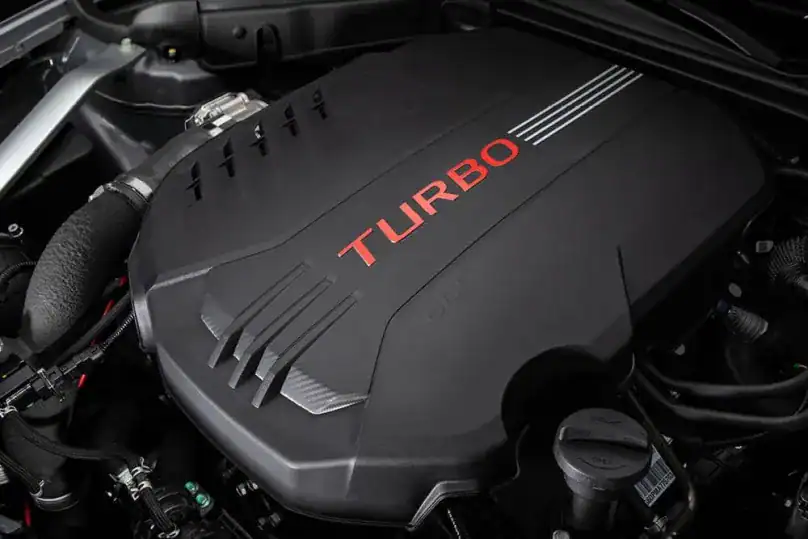
13.3-litre V6 Twin Turbo from the Kia Stinger
The standout candidate is Kia’s 3.3-litre V6 twin-turbo engine, which is currently used in the high-performance Kia Stinger. This engine is a power-packed unit, delivering 272kW and 510Nm of torque—figures that would provide the Tasman with plenty of muscle for towing, off-roading, and hauling heavy loads.
Why Kia WON’T offer a 6-cylinder engine
Sceptics have cited two major reasons why a six-cylinder Tasman isn’t likely:
- Development costs: Every additional engine option Kia offers adds significant costs, both in terms of development and certification across various markets.
- Environmental regulations: Governments around the world are tightening emissions standards, with Australia being a key market facing pressure to reduce carbon output. In this context, larger engines like the V6 are becoming harder to justify.
- Outperformed: I’m sorry, I know you’re going to hate me for it, but extended-range electric vehicles, like the BYD Shark, are the future. All the experts agree, EREV’s are the best of both worlds. If this is the case, why try to win in the V6 segment that has been shrinking for decades?
These are sound reasons for scepticism, and they align with the industry’s broader trend toward smaller, more efficient engines. However, there are strong hints that Kia has a different plan in mind for the Tasman—and a V6 variant could still be on the horizon.
Evidence suggesting a V6 Tasman is coming
Despite the doubts, there are key pieces of evidence suggesting that a V6 Tasman is in development.
1. Emissions testing on the Stinger engine
The Tasman has been spotted undergoing emissions testing in California with a 3.3-litre V6 twin-turbo under the bonnet—the same engine found in Kia’s performance-focused Stinger. This shows that Kia has already invested in the development and certification of the V6 for the Tasman, and it signals a strong possibility that this option will make it to market.
2. Replacing the Mohave’s V6
Kia’s Mohave, a ladder-frame SUV beloved in the American market, is nearing the end of its production life. The Tasman is set to form the foundation for the Mohave’s replacement, much like how Ford’s Ranger underpins the Everest SUV. The Mohave currently comes with a V6, and given the American appetite for power and performance, it’s unlikely that a 4-cylinder replacement would be accepted by that market. With vehicles like the Sorento and Sportage covering the 4-cylinder SUV segment, it’s logical for Kia to offer a V6 in the Tasman to cater to those wanting more power in a rugged, off-road-capable package.
Kia’s strategic advantage with hydrogen
One factor often overlooked in discussions about the Tasman’s powertrain is Kia’s growing investment in hydrogen fuel cell technology. With governments, particularly in Europe and Asia, pushing for hydrogen as a clean alternative to traditional fuels, Kia could position itself as a forward-looking brand by offering hydrogen-powered variants of the Tasman. In fact, the introduction of hydrogen vehicles to the Australian market could give Kia a unique advantage over rivals like Ford and Volkswagen, who are slower to adopt the technology.
Hydrogen could also provide a way around the emissions restrictions currently hindering the development of larger engines like the V6. By offering hydrogen powertrains, Kia can deliver the performance that power-hungry markets desire while staying on the right side of environmental regulations.
In fact, Toyota’s CEO will be flying to South Korea for strategic talks with Hyundai-Kia surrounding the future of Hydrogen.