
TLDR: Kia has confirmed an electric Tasman is under development and could arrive in showrooms as early as 2026. It may be full-electric, hybrid, or both, and will compete with models like the LDV Terron 9, playing pivotal role in Kia’s strategy for the Australian and American markets.
Kia’s Electrification Roadmap
At the moment, Hyundai Motor Group (HMG) is the 4th largest producer of battery electric vehicles in the world while Kia specifically has ambitious plans to offer 15 EVs globally by 2027. The company’s EV lineup, led by models such as the EV6 and EV9, demonstrates its ability to produce electric vehicles with impressive range, performance, and towing capacity—all crucial factors for an electric utility vehicle. The smaller and more affordable EV3 and EV4 also land this year.
We’ve known an electric pickup is on the way from both Kia and Hyundai, and we have the spy shots to prove it. But we have recently learnt that the Tasman itself will be offered with electric motors. This aligns with a broader strategy to capture market share in the light commercial vehicle segment, particularly in regions like Australia, where utility vehicles are in high demand while emissions standards are tightening.
Join thousands of members!
The Kia Tasman Club is a supportive community that provides advice on modifications and accessories, organise events, and keep you up to date with the latest news and rumours. Best of all, it’s free to join!
Kia confirms an electric Tasman
Rumours of an electric Tasman were confirmed when Christo Valentyn, Kia South Africa’s marketing boss, revealed to Carbuzz that the vehicle is indeed on the way. Valentyn stated, “I’m probably not supposed to say this but… an electric [Tasman] is coming.”
Kia has reportedly been secretly developing an electric version of the 2025 Kia Tasman, with its debut in Australian showrooms tipped for 2026. The EV version is expected to rival utes like the LDV Terron 9 and BYD Shark 6.
BEV, HEV, EREV? It’s confusing…
It remains unconfirmed whether the Kia Tasman will be offered as a battery-electric vehicle (BEV), a traditional hybrid electric vehicle (HEV), an extended range electric vehicle (EREV), or a combination of these options.
It is worth noting that a BEV pickup will be a monocoque design, unlike the body-on-frame structure of the standard Tasman. This introduces some uncertainty.
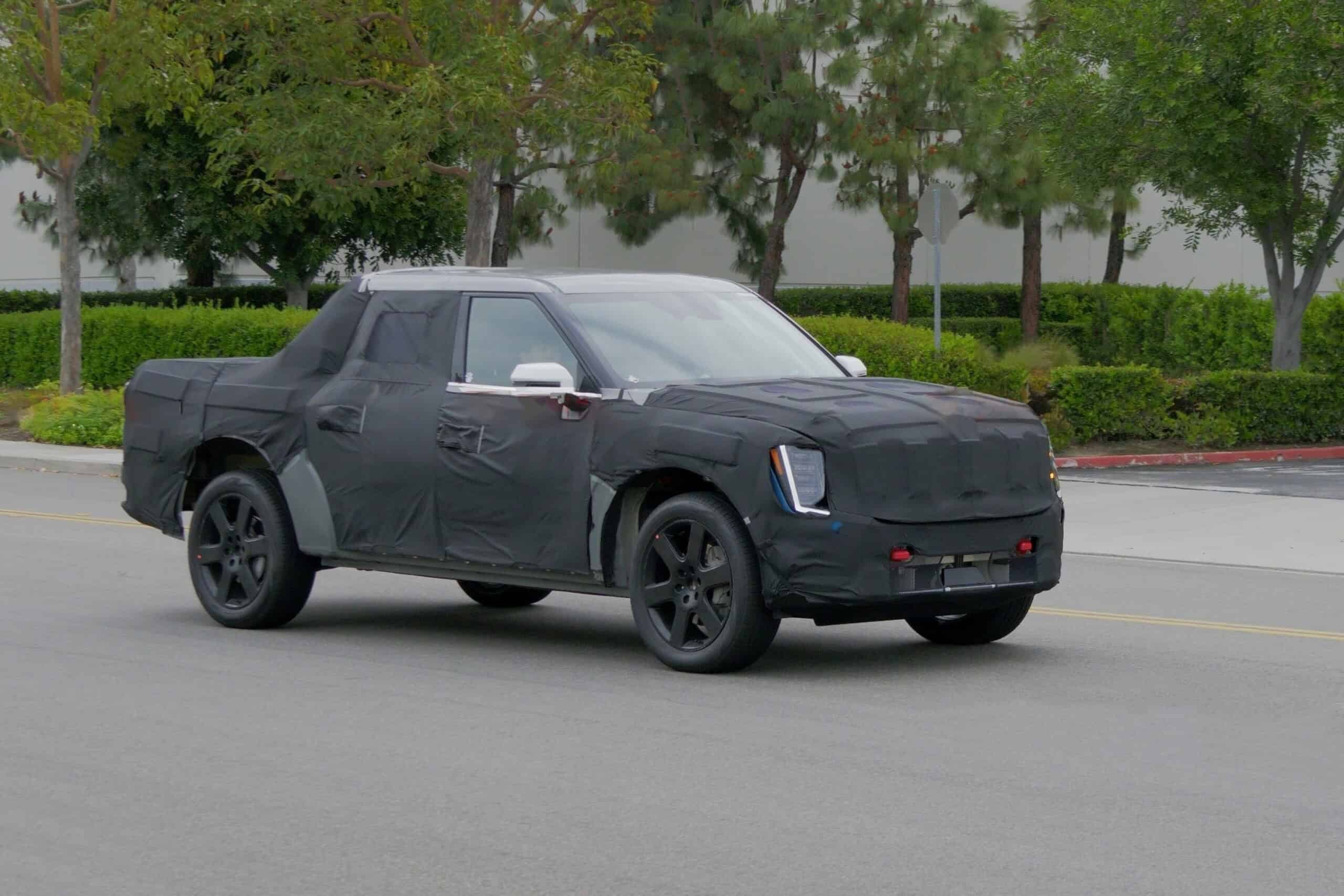
We know Kia are developing a full-size pickup for the North American market, slated for release in 2028. Spy photos have also revealed a mid-size BEV pickup resembling the EV9, spotted in California rather than Korea.
We’ve also seen a Tasman in Korea without a visible exhaust pipe. Later, footage emerged of another Tasman with the distinctive whine of regenerative braking, suggesting that some form of electrification is being applied to the body-on-frame Tasman.
We don’t know if the BEV spotted in California will carry the Tasman name or launch as an entirely separate model. Given the full-size pickup is still several years away, this mid-size BEV may represent an early iteration of the upcoming full-size American pickup.
Battery Electric (BEV)
The Tasman could leverage the same E-GMP platform that powers the EV-9 and IONIQ 5 N, which supports fast charging and long-range capabilities. The EV9’s powertrains include:
- RWD Single-Motor: 160 kW / 350 Nm, 0-100 km/h in 8.2 seconds, and a 76.1 kWh battery with a WLTP range of 443 km.
- AWD Dual-Motor: 283 kW / 700 Nm, 0-100 km/h in 5.3 seconds, and a 99.8 kWh battery with a WLTP range of 541 km.
That’s an impressive offering. However, these figures are likely to differ when applied to the Tasman. While the EV9 already boasts a 2,500kg towing capacity—remarkable for an electric SUV—we’d expect the Tasman to retain its 3,500kg towing capacity, even in a BEV configuration.
The EV9’s 800-volt E-GMP platform supports ultra-fast charging, allowing it to go from 10% to 80% in just 25 minutes with a 350 kW DC fast charger. It also features 3.68 kW bi-directional charging, enabling both vehicle-to-load (V2L) and vehicle-to-grid (V2G) functionality. In comparison, the ICE Tasman’s inverter outputs only 400W through the tub’s power sockets. A BEV Tasman, with significantly higher output, would be ideal for powering tools, setting up a campsite, or maximising your solar panels—particularly useful for those living off-grid.
Kia could also be building the Tasman not upon their E-GMP platform, but instead upon the newer Integrated Modular Architecture (IMA) which comes in two forms. The eM platform is designed for passenger vehicles such as the Kia EV8 or Genesis GV90, and the eS platform that is the basis for Kia’s other push into the light commercial segment, the purpose-built vehicles (PBVs).
Traditional Hybrid (HEV)
A traditional hybrid combines a combustion engine and electric motors working together to power the wheels. This can be either a standalone hybrid (HEV) or a plug-in hybrid (PHEV).
Kia currently offers two plug-in hybrids: the Niro and the Sorento, both equipped with a 1.6L turbo-petrol engine. In the Sorento, this setup produces a combined output of 195 kW and 350 Nm of torque. With the ability to seamlessly switch between electric and hybrid modes, the Sorento PHEV provides an all-electric range of 50–58 km (WLTP).
While the Sorento PHEV is well-suited to city driving, its towing capacity is reduced to 1,350 kg compared to the ICE Sorento’s 2,000 kg. This lower towing capacity would not meet the requirements for the Tasman, suggesting Kia may need to develop a new hybrid configuration for it. In this case, a more modern extended-range electric vehicle (EREV) setup seems like a more likely choice.
Extended Range EV (EREV)
Hyundai Motor Group is actively developing EREV (extended range electric vehicle) technology to bridge the gap between traditional hybrids and full EVs. If I were to bet on just one electrified version of the Tasman, it would be an EREV.
Kia has announced the 2.5L turbo four-cylinder petrol engine (Theta III T-GDI) for the Tasman in markets like Korea, while only the 2.2L turbo diesel has been confirmed for Australia. This could indicate that the 2.5L petrol, when it arrives in Australia, will be in the same EREV form as the 2026 Hyundai Palisade and Kia Telluride. Leaks suggest this configuration will deliver 449 kW of power and 456 Nm of torque.
Unlike traditional plug-in hybrids that operate in parallel, HMG’s EREV is expected to be a series-parallel hybrid. This allows the vehicle to run in electric-only mode at lower speeds and transition seamlessly to the petrol engine for higher speeds or when extra power is required.
This setup combines the advantages of BEVs—such as instant torque, home charging, superior fuel economy, and bi-directional charging—with the benefits of ICE vehicles, including quick refuelling, extended range, and highway efficiency. A Tasman EREV is likely to offer an electric-only range exceeding 100 km, significantly more than the Ford Ranger PHEV’s sub-50 km range. Smaller batteries also make EREVs more affordable than BEVs.
The BYD Shark 6, which produces 321 kW and 650 Nm, is a popular example of an EREV. While BYD has faced criticism for its small 1.5L generator—rumoured to be upgraded to a 2.0L version—the Tasman EREV could represent a step up. Although it’s possible Kia might use the 1.6L generator from the Sorento PHEV, this seems unlikely, as it wouldn’t align with the Tasman’s performance expectations.

Market for an Electric Tasman
US Production Advantages
Given the United States’ stance against Chinese vehicles, South Korea is likely to remain one of the few sources of affordable EVs for American consumers. If Kia decides to manufacture the Tasman at the Hyundai Motor Group Meta Plant America (HMGMA) in Georgia, it could benefit from incentives under the US Inflation Reduction Act (IRA), which encourages domestic EV production. This would also make the Tasman eligible for federal tax credits, enhancing its appeal to American buyers.
Initially established as a factory dedicated to electric vehicles, the HMGMA plant is now also preparing for EREV production in response to the rising demand for hybrids.
Producing the Tasman in the US would also allow it to avoid tariffs like the chicken tax—one of the main reasons an ICE Tasman has not yet been planned for the North American market. If an EV Tasman is established in US production, it would be a logical step to manufacture ICE versions domestically as well. Given the American preference for powerful vehicles, this could pave the way for a 6-cylinder Tasman—a possibility Kia has notably left open.
Global Market Opportunities
In countries with tightening regulations, such as Australia’s New Vehicle Efficiency Standards (NVES), the demand for electric light-commercial vehicles (e-LCVs) is rising, particularly among fleet operators looking to meet these new requirements.
While BYD has introduced the Shark and Ford is set to launch the Ranger PHEV in 2025, the market remains limited in terms of viable options. Manufacturers that can quickly deliver versatile and capable e-LCVs stand to gain a strong foothold in this emerging segment.