
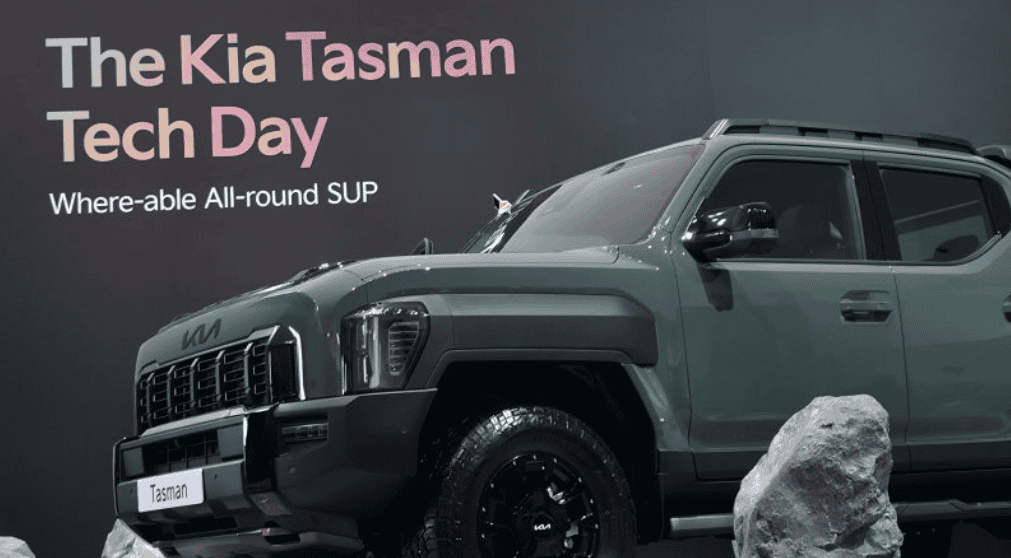
Kia unveiled its first dedicated utility truck, the Tasman, at a technical showcase in Seoul on the 27th of March, outlining key engineering advancements designed to bolster its off-road capabilities, durability, and comfort. The event, held at Sebitseom in Seocho-gu, provided an in-depth look at the platform and performance characteristics underpinning Kia’s latest venture into the utility vehicle market.

Engineering and Structural Integrity
The Tasman adopts a body-on-frame construction, a hallmark of traditional utility vehicles, which Kia claims enhances load-bearing capacity and durability. The chassis comprises two robust longitudinal beams connected by cross-members, a design intended to improve torsional rigidity and withstand harsh driving conditions.
According to Han Yong-so, senior researcher of Kia’s MLV Body Design Team 1, internal simulations indicate the Tasman exhibits a 64% increase in overall strength and a 32% improvement in torsional stiffness compared to the Mojave, an SUV built on a similar ladder-frame platform.
With an approach angle optimised for off-road use, the Tasman offers a minimum ground clearance of 252mm, helping protect critical components during rough-terrain driving. To mitigate cabin vibrations, a multi-skeletal mounting system disperses impact forces, improving ride comfort and structural stability.

Off-Road Capability and Powertrain
Kia has positioned the Tasman as its most off-road-capable vehicle to date, equipping it with a 2-speed active transfer case (ATC) that allows for multiple drive modes. These include 2H (rear-wheel drive), 4H (equal front-rear power distribution), 4L (low-range gearing), and 4A (automatic mode for varying conditions). The Tasman is rated to tow up to 3,500kg, aligning with industry standards for midsize pickups.
For improved water-fording capability, Kia has placed the air intake inlet at 950mm within the side fender. The vehicle can traverse water depths of up to 800mm at speeds of 7km/h without compromising engine function.
The X-Pro variant features additional off-road enhancements, including an electronic differential lock (e-LD) and a dedicated X-Trek mode, which maintains low-speed control on uneven terrain without requiring pedal input. This system is designed to allow drivers to focus on steering while the vehicle manages torque distribution and braking autonomously.
Join thousands of members!
The Kia Tasman Club is a supportive community that provides advice on modifications and accessories, organise events, and keep you up to date with the latest news and rumours. Best of all, it’s free to join!
Cargo and Utility Features
The Tasman’s cargo bed measures 1,512mm in length, 1,572mm in width, and 540mm in height, providing a total load volume of approximately 1,173 litres. It is designed to accommodate standard pallets across various global markets. With a maximum payload capacity of 700kg, the Tasman’s bed incorporates practical features such as integrated divider mounting grooves, a factory-fitted bed liner, tie-down hooks, LED side lighting, and a 220V power inverter.

Ride Comfort and Cabin Refinements
Efforts to improve ride quality have focused on chassis and suspension tuning. The Tasman’s front and rear shock absorbers incorporate frequency-sensitive damping, allowing the vehicle to adapt to varying road surfaces. Urethane bump stops have been employed to further reduce body movement and improve suspension compliance.
Kia has also prioritised noise, vibration, and harshness (NVH) suppression, incorporating double-laminated acoustic glass on the windscreen and front-row windows. Airflow management has been refined to reduce road noise intrusion into the cabin.
Passenger comfort is enhanced by a number of features typically associated with SUVs rather than utility vehicles. These include a panoramic widescreen infotainment system powered by Kia’s ccNC platform, a Harman Kardon premium audio system, and dual wireless charging pads. The Tasman also introduces a reclining second-row seat with a sliding interlock mechanism, a feature uncommon in traditional pickups, aiming to improve long-distance passenger comfort.
With the Tasman, Kia appears to be targeting buyers who require both workhorse utility and SUV-like refinement, a combination that has become increasingly relevant in global pickup markets.
