
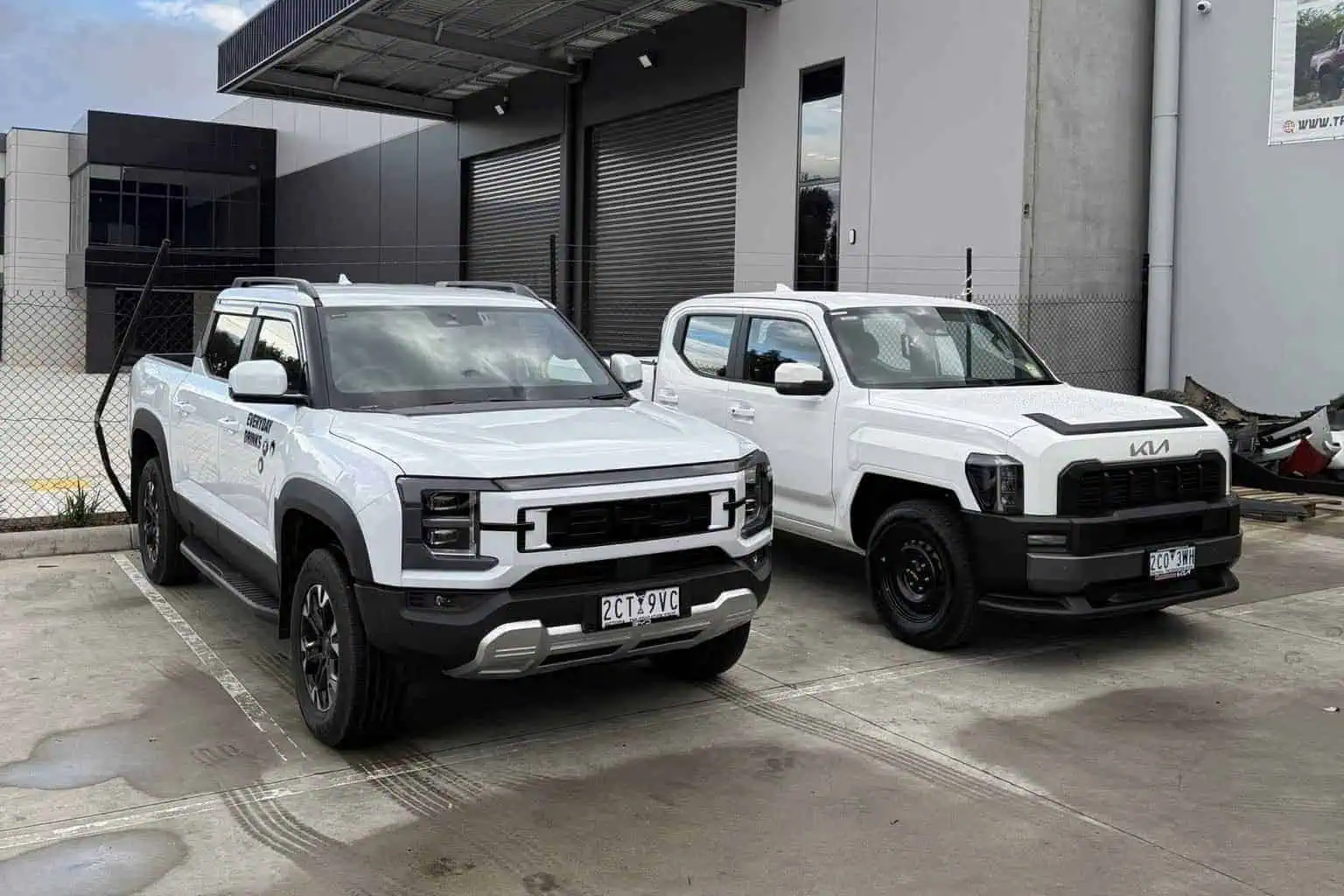
Diesel workhorses like the Kia Tasman are now facing off against plug-in hybrid newcomers such as the BYD Shark 6. While both are dual-cab 4x4s targeting tradies, families, and adventurers alike, they bring very different technologies and priorities to the table.
Powertrain & performance
At the heart of the difference is propulsion. The Kia Tasman sticks to a tried-and-true turbo-diesel formula, while the BYD Shark 6 goes bold with a dual-motor plug-in series-hybrid setup, the first of its kind in the Australian market.
| Spec | Kia Tasman | BYD Shark 6 |
|---|---|---|
| Engine | 2.2L turbo-diesel | 1.5L turbo petrol + dual electric motors (PHEV) |
| Power | 154 kW | 321 kW (combined) |
| Torque | 441 Nm | 650 Nm (combined) |
| Transmission | 8-speed torque converter | E-CVT |
| Drivetrain | 4×2 or 4×4 | AWD |
| 0–100 km/h | ~10 seconds (est.) | 5.7 seconds |
| Braked towing | 3500 kg | 2500 kg |
| Fuel economy | 7.4–8.1 L/100 km | ~1.6 L/100 km (combined cycle) |
| Electric-only range | N/A | Up to 100 km |
| Total driving range | ~1000 km (est.) | Up to 800 km |
The Shark 6 clearly outpaces the Tasman in on-road performance, especially off the line. However, the Tasman claws back with a higher towing capacity and better off-road performance. The Shark uses less fuel, depending on how you use it, but the Tasman still has noticeably more range, even with the Shark’s range-extender.
Join thousands of members!
The Kia Tasman Club is a supportive community that provides advice on modifications and accessories, organise events, and keep you up to date with the latest news and rumours. Best of all, it’s free to join!
Pricing & warranty
Pricing and long-term peace of mind will factor heavily into most buyers’ decisions.
| Spec | Kia Tasman | BYD Shark 6 |
|---|---|---|
| Price (AUD) | $42,990 – $74,990 | $57,900 (launch price) |
| Warranty | 7 years, unlimited km | 6 years / 150,000 km |
| Battery warranty | N/A (diesel only) | 8 years / 160,000 km |
The Kia offers a broader range of trims to suit different budgets, and its longer unlimited-kilometre warranty gives it an edge for buyers racking up serious mileage.
Features & technology
Both utes are well-equipped, but they cater to different audiences.
| Feature | Kia Tasman | BYD Shark 6 |
|---|---|---|
| Infotainment | 12.3″ digital cluster & touchscreen | Panoramic display with HUD |
| Smartphone integration | Wireless Apple CarPlay & Android Auto | Wireless Apple CarPlay & Android Auto |
| Charging ports | N/A | V2L (Vehicle-to-Load) power outlets |
| Safety tech | AEB, Lane Keep Assist, Blind Spot View, 360° camera | AEB, adaptive cruise, lane centring, 360° camera |
| Off-road features | Locking rear diff, terrain modes (X-Pro) | Electric AWD with torque vectoring |
| Interior layout | Dual-screen cockpit | Tech-focused, EV-inspired layout |
Both of these vehicles are packed full of tech, and it’s really a matter of preference.
The Shark 6 stands out for its hybrid layout which offers unique features like V2L power export, allowing for a whopping 6.6kW of output, far outstripping the Tasman’s 400W. It also makes use of a large, tablet-like swivel screen makes the Shark the “Tesla of utility vehicles”.
The Tasman, while still packed full of tech, provides a more rugged, conventional experience. Screens and other technology take a backseat as Kia provides prominent tactile buttons, knobs, switches, and handles. Mechanical off-road aids may appeal more to those venturing far from WiFi, while the back seats not only recline, but also fold both up and down, with under-seat storage.


Final thoughts
The Kia Tasman is a solid, reliable diesel ute with strong towing credentials and long-range touring ability. It’s the safer choice for buyers who value proven mechanicals and a broad service network.
The BYD Shark 6, meanwhile, is a bold move into electrified utility. With blistering performance and ~80km of EV-only range, it’s a strong option for early adopters who don’t need to tow or carry large loads.
Both vehicles are compelling in their own right—and the growing diversity in Australia’s dual-cab market means there something to suit everyone.
It’s also known that BYD will be bringing another, 2L Shark that is expected to add 3.5t towing, while Kia is developing a full battery EV pickup, and a PHEV Tasman is also expected to compete more directly with the Shark.